
Multi-Unit Water Damage Restoration Case Study: A Simple Water Leak Turned Into a Commercial Disaster
On the morning of 12 December 2025, our team received an urgent call from a property manager in Newstead, QLD for water damage restoration. A water leak had been discovered in one of the apartments, and what initially appeared to be a small patch of damp carpet quickly revealed itself to be something far more serious. Water was spreading through the building structure, affecting multiple levels and several neighbouring units.
The first signs of trouble were found in the first affected apartment, where the property manager was already on site, worrying about saturated flooring and the possibility of moisture becoming trapped beneath the surface. We arranged immediate access, and our technicians mobilised to assess the situation. At that stage, the cause was still uncertain—was it a burst hose, a plumbing failure, or perhaps an air-conditioning system leaking condensate? By the time we arrived, the active flow had stopped, but the carpets and underlay were already holding significant water.
What unfolded over the next few hours was a complex multi-unit water damage restoration scenario—one involving both a sudden plumbing failure and a long-term HVAC issue. This dual-source water damage required careful diagnostics, structured mitigation, and coordinated repairs to stabilise the building and protect its occupants.
Emergency Water Damage Response for Apartment Buildings
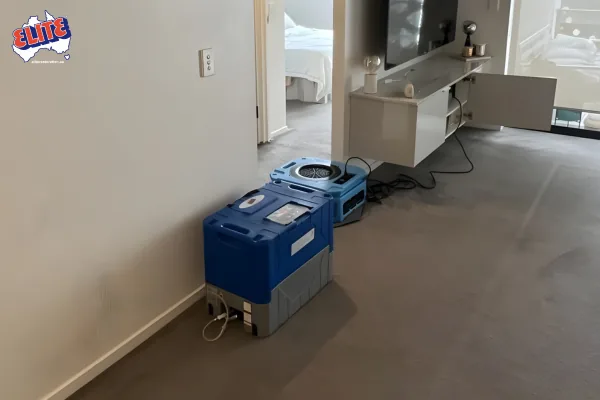
The event began with an urgent call from a commercial property reporting water pooling in an apartment. The immediate concern was the saturated carpet and underlay, which required extraction and removal to prevent moisture from becoming trapped. Early observations suggested Category 1 clean water damage, though the exact source was unclear at first.
Technicians were granted quick access to the site, allowing emergency water damage mitigation to begin without delay. Initial theories pointed to either a cold-water supply issue or a leak from the air-conditioning system, but the flow had already stopped by the time the team arrived.
Water Damage Investigation: Identifying Two Distinct Causes of Loss
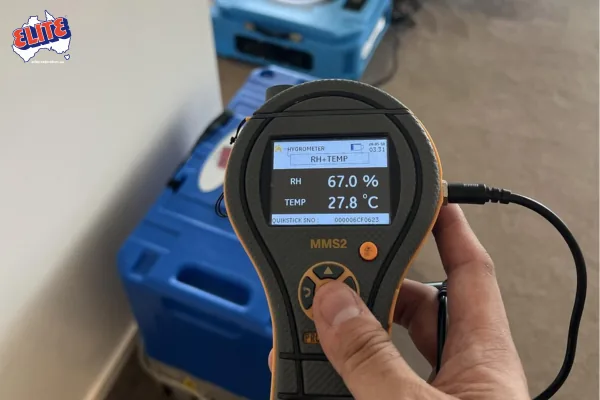
Our technicians soon started their investigation in line with IICRC S500 standard, by using moisture meters, thermal and endoscope cameras. Once moisture mapping and thermal imaging were completed, it became clear that the property was experiencing water damage from two separate sources. For a deeper breakdown of types and categories of water damage, see our detailed guide.
Cause 1: Structural Plumbing Failure – Category 1 Water Damage
The primary water loss originated from an upper-level apartment where a flexible hose connected to a laundry water inlet had burst. Clean water spread across the flooring before migrating downward through the building structure.
The affected areas contained rubber sponge underlay, a material known for absorbing and retaining large volumes of water. This significantly increased the extent of the damage and required a more intensive structural drying process.
Cause 2: Chronic HVAC Condensate Leak – Condition 2 Moisture
A second moisture-affected area was discovered beneath an air-conditioning unit. This location was remote from the plumbing failure, indicating a separate issue.
Moisture was detected in wall sections and window framing, and early surface mould was observed on personal contents stored nearby. The occupant confirmed that the AC unit had been leaking for an extended period. This long-term moisture exposure aligned with IICRC Condition 2, involving early mould activity and settled spores.